FEDERAL MARITIME COMMISSION
Fiscal Year 2012
(Excerpted)

- Strategic Goal 1: Maintain an Efficient and Competitive International
Ocean Transportation System - Strategic Goal 2: Protect the Public from Unlawful, Unfair, and Deceptive
Practices and Resolve Shipping Disputes


- A. IN GENERAL
- B. TOP TWENTY U.S. LINER CARGO TRADING PARTNERS
- C. BUREAU OF CERTIFICATION AND LICENSING


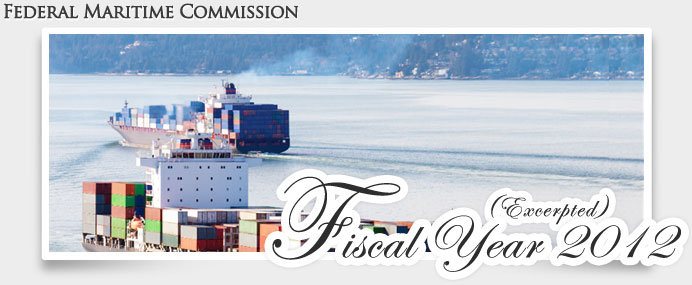


As U.S. economic growth slowed during the first three quarters of fiscal year 2012, so too did the demand for ocean transportation. However, capacity adjustments implemented by carriers did not cause the vessel capacity shortages experienced in fiscal year 2010. For much of fiscal year 2012, shippers were able to ship their goods at much lower cost than in 2011. Meanwhile, liner vessel operators reported sharply lower earnings, resulting from lower rates across the board. In the latter part of fiscal year 2012, however, carriers began implementing a series of general rate increases that were able to generate increased revenue. Looming over the industry during the last quarter of fiscal year 2012 was the possibility of a strike by U.S. east coast dockworkers. That possibility led most carriers to publish significant congestion surcharges. As the fiscal year closed, dockworkers and ship owners were engaged in renewed talks to avoid a strike.
The Federal Maritime Commission's mission is to foster a fair, efficient and reliable international ocean transportation system, and to protect the public from unfair and deceptive practices. The highlighted actions under the Commission's Strategic Goals provide an overview of agency activities in pursuit of its mission.
Strategic Goal 1: Maintain an Efficient and Competitive International
Ocean Transportation System
The FMC is charged with ensuring competitive and efficient ocean transportation services for the shipping public. Competition in U.S. trades helps to foster competitive rates and encourage diverse service offerings far the benefit of U.S. exporters and importers, and ultimately consumers. The 1984 Act grants ocean carriers and MTOs limited antitrust immunity for activities pursuant to agreements they file with the Commission. The carriers and terminal operators are subject to the FMC's monitoring of their activities to guard against possible abuse of that limited immunity, to avoid unreasonable increases in transportation costs or decreases in transportation services, and to guard against other activities prohibited by the 1984 Act.
During fiscal year 2012, the Commission concentrated on facilitating U.S. exporters' access to foreign markets via ocean transportation, supporting the economic recovery, protecting American consumers, encouraging a sustainable ocean transportation industry, enhancing safety and security, and monitoring foreign practices to protect American jobs. The Commission continued to closely monitor concerted activities of carriers, particularly in the transpacific trades, to ensure that agreement members did not cause unreasonable increases in rates or unreasonable reductions in service. In addition, the Commission monitored the availability of ocean container chassis as carriers decided to shift the responsibility and cost for securing chassis to shippers.
The Commission’s Bureau of Trade Analysis issued its Study of the 2008 Repeal of the Liner Conference Exemption from European Union Competition Law. The study collected and analyzed data on the impact of the October 2008 European Union repeal of its block competition law exemption for liner conferences. Data analyzed included information regarding changes in carrier market structures, competition, services, vessel capacity, rates, and surcharges. The study concluded that:
- The repeal of the block exemption did not appear to have caused any negative impact on U.S. liner trades.
- The activities of carrier rate discussion agreements in the U.S. trades do not appear to have increased average rates relative to rates in EU trades, but may have contributed to modestly reduced rate volatility.
- The repeal may have resulted in a modest increase in market concentration, but not such that world present problems.
Supporting U.S. exports and the economic recovery: During fiscal year 2012, exported goods continued to grow, on pace to exceed the National Export Initiative's goal of doubling U.S. exports by 2015. While vessel capacity and container availability met demand, the Commission continued to use recently established Rapid Response Teams to provide prompt solutions for commercial disputes between carriers and their customers.
The Commission also assisted the U.S. Department of Agriculture's Agricultural Marketing Service (AMS) with its exporters' project to give more transparency and visibility to the chronic problem of locating empty containers for exports. AMS' Ocean Shipping Container Availability Report (OSCAR) is published weekly and shows container availability at 18 U.S. port and inland locations, using data provided by nine leading ocean carriers. The report helps U.S. exporters determine weekly container availability, and provides projections two weeks in the future.
Economic Assistance to Small Businesses: In fiscal year 2011, the Commission approved a rule change to conditionally exempt more than 3,300 licensed non-vessel-operating common carriers (NVOCCs) from the costs and burdens of publishing in tariffs the rates they charge for cargo shipments. In fiscal year 2012 move than 3,500 NVOCCs could take advantage of this exemption. Most NVOCCs are small businesses who could see significant savings from the exemption. The Commission followed up in fiscal year 2012 with an inquiry to solicit public comments on suggestions for further improvement to its rules including extending the conditional exemption to foreign-based NVOCCs.
Marine Environmental Committee and Clearinghouse: The FMC has seen environmental issues become increasingly central to the agreements and shipping practices it monitors. The Commissions Marine Environmental Committee reviews filings at the agency for best environmental practices which can be put forward as models for adoption by other ports and companies. The Commission also has created a webpage to serve as an environmental issues clearinghouse for information on maritime environmental issues, news, resources, laws and regulations, and best practices. The Commission held a public Forum on Port Environmental Initiatives in April 2012 where representatives from the ports of Houston, Long Beach, Los Angeles, New York/New Jersey, Oakland, and Virginia gave presentations on their environmental and sustainability initiatives and engaged in general discussion with Commissioners about the future of port environmental issues.
Container Freight Index-Based Service Contracts: The Commission amended its service contract regulations to give shippers and carriers more flexibility and certainty in their use of long-term service contracts. The new rule permits periodic adjustment to freight rates contained in multi-year contracts using an index reflecting changes in market conditions, so long as the index is readily available to the parties and the Commission.
Cargo Diversion: As a result of requests from two U.S. senators and several members of the House of Representatives, the Commission conducted a study of the impacts and the extent to which the Harbor Maintenance Tax (HMT), other U.S. policies, and other factors may incentivize inbound container cargo to shift from U.S. seaports to competing ports located in Canada and Mexico. Accordingly, the Commission published an inquiry soliciting public views and information concerning the factors that may cause or contribute to such a shift in cargo. The Commission's report was issued in the fourth quarter of fiscal year 2012 with the following conclusions:
- Carriers shipping cargo through Canadian and Mexican ports violate no U.S. law, treaty, agreement, or FMC regulation.
- Numerous factors account for why shippers elect to use ports in Canada or Mexico. They include overall shipment savings, risk mitigation through port diversification, perceived transit time benefits, avoidance of the HMT and rail rate disparities.
- Congress has many options to consider should it decide to revise or replace the current HIM structure.
Strategic Goal 2: Protect the Public from Unlawful, Unfair, and Deceptive
Practices and Resolve Shipping Disputes
The FMC has a wide variety of responsibilities to protect the public from financial harm, including assisting in the resolution of disputes related to the shipment of goods or the carriage of passengers, investigating and prosecuting unreasonable or unjust practices, and ruling on formal complaints alleging violation of the 1984 Act. The FMC contributes to the integrity and security of the nation's supply chain and transportation system by identifying unlicensed operations and licensing only those ocean transportation intermediaries with appropriate character and financial responsibility. The FMC also ensures financial coverage of passenger vessels to indemnify passengers in the event of nonperformance. Pursuant to these regulatory responsibilities the Commission undertook a number of significant actions during fiscal year 2012 to address issues affecting American consumers who ship their personal goods overseas or take cruises.
Household Goods Shipments: The Commission undertook several actions as a result of the fiscal year 2011 Fact Finding Officer's report in Fact Finding Investigation No. 27, Potentially Unlawful Unfair or Deceptive Ocean Transportation Practices Related to the Movement of Household Goods or Personal Property in U.S.-Foreign Oceanborne Trades. Each year, the FMC receives several hundred complaints from individuals who have experienced problems with their international household goods shipments. To address this continuing issue, in fiscal year 2012 the Commission took the following actions:
- Consumer Education: The Commission launched a redesigned and restructured website that improved both content and delivery of information, including better information and tools to help the public shopping for international shipping options; entered into a formal Memorandum of Understanding with the Federal Motor Carrier Safety Administration (FMCSA) to conduct joint investigative operations against international and interstate movers with a history of chronic complaints and violations and to engage Commission ombuds support in resolving problems for consumers; developed relationships for enhanced cooperation with trade associations representing household goods movers; developed information for OTIs to distribute to consumers moving household goods; targeted outreach to local communities, particularly certain ethnic communities that regularly ship household goods overseas; and encouraged household goods movers to link their websites to the FMC's website for consumer information.
- Licensing Issues: As the Commission reviews its licensing regulations, it will pursue recommendations for adjustments that specifically address issues affecting household goods shipments.
Preventing Fraud and Enhancing Safety and Security: The Commission's Bureau of Enforcement and Area Representatives continued efforts to investigate and prevent practices that are unfair and deceptive. Targeted violations included misdescription of cargo, which also poses a serious safety and security risk because it could prevent vessel operators and port officials from knowing whether dangerous goods are being transported on vessels into the United States. During 2012, the Commission completed 12 cases by collecting $838,000 in penalties for such violations.
Monitoring Foreign Practices to Protect American Jobs: The Commission also was vigorous in carrying out its charge to monitor and prevent practices by foreign governments or entities that adversely affect American commerce. The Chairman hosted a visit from the Shanghai Shipping Exchange (SSE) to jointly discuss regulatory issues of China and the U.S. and create a climate of cooperation to overcome any barriers to international trade with China.
Dispute Resolution: During fiscal year 2012, 670 complaints were received that necessitated the opening of cases to provide dtspute resolution services. This was a 19 percent increase over the volume of cases in fiscal year 2011 and included 132 passenger complaints about cruise line issues, 274 complaints with respect to household goods shipments, and 264 complaints involving other cargo shipment matters.
Participation of the parties in confidential ADR services can provide a means for immediate, cost-effective resolution through cooperation between parties. Confidentiality is essential to the success of such efforts, especially considering the confidential nature of service contracts. Cargo shipment complaints continued to be of increasing complexity. Problems involving ocean transportation intermediaries with overextended finances and inability to complete the ocean transportation continued to be an issue. In addition, many household goods complaints pertained to initial charges quoted vis ávis the actual charges billed, often due to measurement discrepancies.
Technology and Stewardship of Resources: Strategic management of the FMC's human resources, property management, financial and procurement practices and other vital support activities is essential to meet the agency's regulatory and programmatic goals. The FMC realizes the need to use new information technology (IT) as a means of improving agency business processes and augmenting the accessibility of the public conducting licensing or legal business with the agency. In fiscal year 2012, the Commission explored various means to update and revise its existing IT infrastructure to meet agency needs and government-wide standards, and to improve efficiency of operations. System improvements are critical to the Commission’s ability to carry out its mission, especially in an era of increasing demands but declining human resources.