FEDERAL MARITIME COMMISSION
Fiscal Year 2012
(Excerpted)

- Strategic Goal 1: Maintain an Efficient and Competitive International
Ocean Transportation System - Strategic Goal 2: Protect the Public from Unlawful, Unfair, and Deceptive
Practices and Resolve Shipping Disputes


- A. IN GENERAL
- B. TOP TWENTY U.S. LINER CARGO TRADING PARTNERS
- C. BUREAU OF CERTIFICATION AND LICENSING




A. IN GENERAL
The Foreign Shipping Practices Act of 1988, which became effective on August 23, 1988, directs the Commission to investigate and address adverse conditions affecting US. carriers in US. oceanborne trades, when such conditions do not exist for foreign carriers in the United States under U.S. law or as a result of acts of U.S. carriers or others providing maritime or maritime-related services in the United States.
In fiscal year 2012, the Commission monitored potentially unfavorable of discriminatory shipping practices by a number of foreign governments. However, no direct FSPA action was necessary.
B. TOP TWENTY U.S. LINER CARGO
TRADING PARTNERS
Pursuant to the FSPA, the FMC must include in its annual report to Congress "a list of the twenty foreign countries which generated the largest volume of oceanborne liner cargo for the most recent calendar year in bilateral trade with the United States," 46 U.S.C. 306 (b)(1).
The Journal of Commerce’s Port Import Export Reporting Service (PIERS) database was used to derive the Commission’s list of top twenty trading partners. The most recent complete calendar year for which data are available is 2011. The table on the next page lists the twenty foreign countries that generated the largest volume of oceanborne liner cargo in bilateral trade with the United States in 2011. The figures in Table 1 represent each country’s total U.S. liner imports and exports combined in thousands of TEUs.
Table 1: Top Twenty U.S. Liner Cargo
Trading Partners (2011)
Rank |
Country | TEUs (000s) |
| 1 | China(PRC) | 10,572 |
| 2 | Japan | 1,452 |
| 3 | South Korea | 1.355 |
| 4 | Taiwan(PRC) | 1,142 |
| 5 | Hong Kong(PRC) | 942 |
| 6 | Germany | 783 |
| 7 | India | 743 |
| 8 | Vietnam | 681 |
| 9 | Brazil | 604 |
| 10 | Belgium and Luxembourg | 563 |
| 11 | Indonesia | 517 |
| 12 | Italy | 499 |
| 13 | Thailand | 479 |
| 14 | Netherlands | 429 |
| 15 | United Kingdom | 403 |
| 16 | Guatemala | 352 |
| 17 | Honduras | 339 |
| 18 | Malaysia | 338 |
| 19 | Australia | 307 |
| 20 | Chile | 304 |
There was a 4 percent year-to-year increase in liner volumes in the United States’ bilateral trade with its top twenty trade partners. The membership of the top twenty list has remained the same, and the top eight countries have remained identical, since 2009. Allowing for some shifts in their individual rank order, the top six countries have topped the list for more than ten years. Three of the top twenty posted year-to-year volume increases of 10 percent or greater - Guatemala, Honduras and Chile. Bilateral liner trade with China had the least positive change in volume from the previous year. Three countries had a negative growth rate- Indonesia, Thailand and Hong Kong.
C. BUREAU OF CERTIFICATION AND LICENSING
1. In Genral
The Bureau of Certification and Licensing has responsibility for the Commission’s ocean transportation intermediary (OTI) licensing program and passenger vessel certification program. The Bureau:
- Licenses and regulates OTIs, including ocean freight forwarders and non-vessel-operating common carriers (NVOCCs).
- Issues certificates to owners and operators of passenger vessels that have evidenced financial responsibility to satisfy liability incurred for nonperformance of voyages or for death or injury to passengers and other persons.
- Manages programs assuring financial responsibility of OTIS and passenger vessel operators, by developing policies and guidelines, and analyzing financial instruments and financial reports.
- Develops and maintains information systems that support the Bureau’s Programs and those of other Commission entities.
The Bureau is organized into two offices: the Office of Transportation Intermediaries and the Office of Passenger Vessels and Information Processing. The former reviews and approves applications for OTI licenses, and maintains and updates records about licensees. The latter reviews applications for certificates of financial responsibility with respect to passenger vessels, manages ail activities with respect to evidence of financial responsibility for OTIs and passenger vessel owner/operators, and develops and maintains all Bureau databases and records of OTI applicants and licensees.
2. Licensing of Ocean Transportation Intermediaries
OTIs are transportation middlemen for oceanborne cargo moving in the US. foreign trades. There are two types: NVOCCs and ocean freight forwarders. NVOCCs are common carriers who do not operate the vessels by which transportation is provided. Ocean freight forwarders in the United States arrange for the transportation of cargo with a common carrier on behalf of shippers and process documents related to those shipments. Both NVOCCs and ocean freight forwarders must be licensed by the Commission if they are located in the US. NVOCCs doing business in the U.S. foreign trades but located outside the United States (foreign NVOCCs) may choose to become licensed, but are not required to do so. Whether licensed or not, foreign NVOCCs must establish financial responsibility. All NVOCCs must publish electronic tariffs which contain the NVOCC’s rates, charges, rules and practices.
To become licensed by the Commission, an OTI must establish that it has the necessary character to render OTI services as well as establish its financial responsibility by means of a bond, insurance, or other instrument and through its Qualifying Individual (QI), has a minimum of three years of experience in ocean transportation intermediary activities in the U.S. An investigation of the applicant’s qualifications addresses such issues as accuracy of information provided in the application; integrity and financial responsibility of the applicant; character of the applicant and its QI; and length and nature of the QI’s experience handling OTI duties. Licensed ocean freight forwarders must establish financial responsibility in the amount of $50,000, and licensed NVOCCs, $75,000. An additional $10,000 of coverage is required for each unincorporated branch office in the United States other than one used to establish a U S. presence, for a foreign licensed NVOCC.
If an OTI is a licensed NVOCC, it must file a Form FMC-1 and publish a tariff. Furthermore, non-U.S.-based NVOCCs that do not wish to be licensed must provide the Commission with proof of financial responsibility in the amount of $150,000, file a Form FMC-1, and ensure a tariff is published at the site listed on the Form FMC-1. A non-U.S.-based NVOCC must list in its tariff an agent for service of process in the United States, and it must use a licensed OTI for any OTI services performed on its behalf in the United States. The financial instrument must be available to pay claims against the OTI arising from its transportation-related activities, any order of reparation assessed under the Shipping Act, and any judgments for damages against an OTI arising from its transportation-related activities under the Shipping Act.
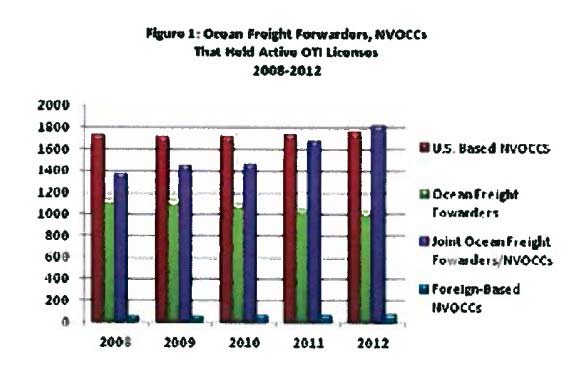
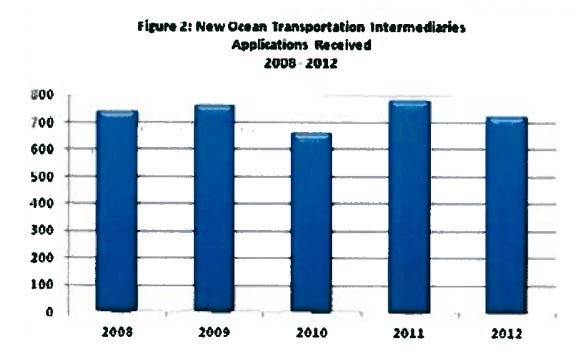
During fiscal year 2012, the Commission received 441 new OTI applications and 278 amended applications, issued 363 new OTI licenses, and revoked 261 licenses. At the end of the fiscal year, 1,030 OFFs, 1,759 US.NVOCCs, 1,807 joint NVOCC/OFFs, and 70 foreign NVOCCs held active OTI licenses. An additional 1,233 foreign NVOCCs maintain proof of financial responsibility on file with the Commission, but choose not to be licensed. Overall, there are 200 more licensed and/or bonded OTIs, representing approximately a 3.5 percent increase from 5,699 OTIs in fiscal year 2011 to 5,899 in fiscal year 2012. U.S. NVOCCs may file riders to their existing NVOCC bonds to meet financial responsibility requirements imposed by the Chinese government. The Commission received 154 riders providing optional proof of financial responsibility for NVOCCs serving the U.S.-China trade last year; 23 riders were terminated. As part of its continuing outreach effort, the Bureau in FY 2012 handled over 5,300 inquiries regarding licensing and related OTI issues. Figure 1 shows the number of freight forwarders and NVOCCs that held active OTI licenses over the past five fiscal years from 2008 through 2012.
The Bureau worked diligently during the fiscal year to streamline the OTI licensing process and reduce the time needed to reach a licensing decision. The Commission’s goal was to complete 70% of all OTI license applications within 60 calendar days during fiscal year 2012. The Bureau exceeded its goal by 20%, completing over 90% of all OTI applications within 60 business days.
The automated Form FMC-18, Application for an OTI License, permits filers to complete an OTI application on-line, scan and attach required documents, and submit the application electronically. The filing system incorporates significant security features for the purpose of protecting applicant data, and detecting and preventing unauthorized system intrusion. The Bureau seeks additional efficiencies in its OTI licensing program through improvements to the automated Form FMC-18 system. In FY 2012, 95 percent of all incoming OTI applications received were through the electronic system. Figure 2 shows the number of new applications processed over each of the last five fiscal years, 2008 through 2012.
3. Passenger Vessel Certification
The Commission administers 46 U.S.C. 44102-44103, which requires evidence of financial responsibility for vessels which have berth or stateroom accommodations for 50 or more passengers and embark passengers at U.S. ports and territories. At the end of FY 2012, the program encompassed 205 vessels and 40 operators, which had aggregate evidence of financial responsibility coverage in excess of $323 million for nonperformance and over $678 million for casualty. Certificates of performance cover financial responsibility for the indemnification of passengers for nonperformance of transportation. This requirement also helps prevent unscrupulous or financially weak operators from operating from U.S. ports. The required levels of coverage for nonperformance are determined by Commission regulation not to exceed $15 million per entity. Even after an operator has ceased operations and dissolved its corporate existence, the evidence of financial responsibility is still valid and available to claimants. Certificates of casualty are required to cover liability that may occur for death or injury to passengers or other persons on voyages to or from U.S. ports. The law provides for $20,000 coverage per person for the first 500 passengers, and the scale decreases to $5,000 per person for passengers in excess of 1,500. U.S. Customs and Border protection are directed to refuse clearance to any vessel which does not comply with the FMC’s evidence of financial responsibility requirements for casualty and performance. During FY 2012, the Commission approved and issued 13 casualty certificates and 15 performance certificates.
In conjunction with CADRS, the Bureau offers information and guidance to the cruising public on passenger rights and obligations regarding monies paid to cruise lines that fail to perform voyages. Over the past few years, a number of cruise operators discontinued operations or filed for bankruptcy. When cruise lines fail to perform because of bankruptcies or other failures, the Commission works closely with the cruise line and the financial responsibility provider, if necessary, to facilitate the refund process. The public is kept informed through press releases posted on the Commission’s website and advice given to passengers who contact staff. During FY 2012, no cruise operator ceased operation with unperformed cruises.
The Bureau reviewed passenger vessel operator activities and operations by monitoring current industry events and examining cruise lines’ unearned passenger revenue (UPR) information. Oversight of cruise line operations and activities ensures compliance with applicable statutes and Commission regulations. No on-site review was conducted this fiscal year. A rulemaking, as approved by Commission vote on July 14, 2011, was initiated to strengthen protections for cruise line customer deposits and prepayments and to reduce financial responsibility requirements for small cruise lines. This Notice of Proposed Rulemaking (NPRM) was issued on September 13, 2011, providing for public comment by November 21, 2011. The NPRM proposed to double the maximum coverage requirement for larger cruise lines from $15 million to $30 million, with a two year phase in period; adjust the maximum coverage requirement automatically to account for inflations, give relief to smaller vessel operators lay reducing their coverage requirements to account for alternative forms of financial protections available to their customers, revise the application form, and add an expiration date to the Certificate (Performance); and make some technical adjustments to the regulations. Analysis of the comments to the NFRM and options for Commission action were presented to the Commission for consideration.
* Entrusted by FMC, SSE delivered excerpts from its report of Federal Maritime Commission Fiscal Year 2012. For more information, please visit: www.fmc.gov.